Monday, October 27, 2008

BoA: Cultural Globalization in Action

While the political and economic dimensions of globalization have been the focus of the majority of my blog posts, I would here like to explore the cultural dimensions, taking as my inspiration the recent release of BoA's first English single (along with a new album in the U.S.) Although the importance of culture in understanding globalization is often overlooked, culture is a driver of change just as important as politics or economics. Particularly in the last ten to twenty years, it has affected the way people consume products (in what way they choose to look, what their material goals are) but also how people conceive of themselves in the context of culture. Within the past eight years the proliferation of internet based media has made cultural entertainment products globally accessible on a level never seen before. Anyone with a computer and an internet connection can access a wide variety of cultural products through such services as YouTube, Veoh, iTunes, and host of other sites. However, until very recently the forces of globalization have acted primarily to export American culture elsewhere in the world.

The American music industry demonstrates the one sided nature of cultural globalization particularly well. One can find top ten albums and singles by American artists in nearly every country, however it has been rare for foreigners to have chart success in the U.S. Additionally, it is unheard of there being any popular Asian singers in the U.S. There is the rare British or Canadian artist that achieves success stateside, but those countries are culturally the closest to American culture. This suggests a surprising degree of insularity for a country that sees itself a nation of immigrants and a melting pot of different cultures. By contrast, Japan is a largely mono-ethnic nation such as Japan, that is in many ways much more receptive to global cultural, demonstrated by the popularity of 3rd culture artists such as BOA or Utada Hikaru. The failure of Japanese music artists to achieve popularity abroad was affected by the economic dominance of the West until very recently, and on a micro level, confusion about how to market Asian artists in the US due to existing stereotypes.
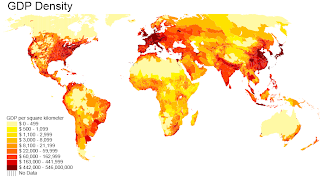
America’s global cultural chauvinism can be seen as a function of economic power. As America and Europe had the most economic power in the world, it was only natural that that Western culture would be more likely to be exported abroad in the form of not only products, but entertainment. The higher GDP per capita is the more disposable income consumers have to spend in such areas as entertainment, creating a more sophisticated pop-culture industry. As one can see by clicking on the above link, the majority of higher GDP per capita nations are still concentrated in North America and Europe. In Asia, only Japan, Korea, and Taiwan posess GDP per capita on a level equal to or higher than most European or North American nations. However, the global balance of economic power seems to be shifting ever increasingly away from Europe and America, and towards Asia, particularly China and Japan. As can be see on the graphic to the right there are already large concentrations of GDP in Japan, Korea, and North Eastern China equal to those in Western countries (indicated by deep scarlet). Japan has already reached a point where it is exporting culture to most of Asia in the form of Hamasaki Ayumi, Utada Hikaru, Johnny’s boy bands, manga, anime, fashion, and movies. Korea too has begun exporting its popular drama and music groups to the rest of Asia. With most of the acts listed before being fluent in several languages, including English, it seems only a matter of time before one of them makes significant waves on a more global scale.

BOA is a prime example of cultural globalization at work. She is a trilingual Korean singer whose biggest market is Japan, and her new album will be in entirely in English. She is demonstrative of the openness of Japanese culture to new ideas and culture from abroad. Japan has had a history of adopting foreign cultural ideas and rapidly remodeling it into something that is uniquely Japanese. In the same way, BOA’s Korean identity was not de-emphasized, however she was marketed as being kawaii ( the Japanese word meaning cute), a particularly Japanese image. She was presented as something both foreign, and therefore interesting, but also something safe. For that reason, her popularity in Japan easily exceeds her popularity in Korea, and the majority of her record sales and endorsements are in Japan. Narrowly she can be seen as part of the Korean Wave, the great increase in cultural exchange between Japan and South Korea, but more broadly as Japan’s growing openness to international trends, fashion, and culture.

The last time a Japanese artist had success in the U.S. was 1961, when a song called “sukiyaki”reached number one. Utada Hikaru, Japan's leading pop singer (both critically and commercially) attempted to release an album in 2005. Despite Utada having grown up in New York City and being a native speaker of the English language that effort failed to sell over 50,000 copies in the U.S. (although in Japan, it is the best selling English album ever). It is important to note that attempt involved a rather radical change of artistic representation that left Utada the artist in an awkward position. Her Japanese image is that of an intelligent, slightly dorky, musician, otherwise a multidimensional personality. However her American label decided to market her in different manner, most notably wearing a bikini under a clear raincoat for her lead single, “Easy Breezy”. In comparison to the video for either her previous Japanese single "Colors" or the following single "Be My Last", she is portrayed so differently as to almost make one wonder if it is the same person. If one goes further to actually analyze the lyrics you find an even greater disparity. The lyrics for both Japanese songs are sophisticated analyses on life and human. relationships, whereas the most memorable part of the American single was the line, "You're Easy Breezy and I'm Japaneezy". In order to sell albums, Island Records chose to reduce Utada to a one dimensional character that failed to resonate with the music buying public. American media commonly responds to Asian females, by exoticiing and over-sexualing them.

BoA also seems to be facing the same pressure to adapt to the American market, by presenting herself in a more aggressive and sexual manner in the video for the new single,"Eat You Up". When compared to the video for "Eat You Up" with either of her preceding Japanese singles,“Kissing You”and “Sparkle”, it is apparent that it has been decided to shift her away from a kawaii image towards a more sexual, urban image. This corresponds to previous portrayals of Asian women in American media. However, because this method did not work for Utada, it seems questionable how successful it will be for BoA. Fortunately for BoA, her lead single avoids any lyrical blunders on the scale of the before mentioned "japaneezy" line. It remains to be seen if BoA can create a image capable of engaging the American's public's attention, and then maintaining that attention long enough to establish a career.It will be difficult for BoA to carve out an individual artistic personality without first erroding stereotypes held by many Americans. As Asia becomes a more powerful economic presence, the amount of Asian culture that is exported abroad will likely chip away at American stereotypes. However, hit single or not, that may just be too late for BoA.

Monday, October 13, 2008

Japan on the Net:A Spectrum of Resources

For this week's post, I have expanded my link roll to include twenty high-quality websites and blogs that will supplement my own writings on the blog by allowing readers greater access to related subject matter on the web. In selecting the links, I tried to apply the criteria provided by the Webby Awards and IMSA. In addition to a great deal of high quality economic and finance sites related to Japan, I was also able to discover a few high quality sites pertaining to cultural items such as music, fashion, manga, etc. Since the topic of my blog is Japan's place in globalization, these sites are particularly important, but quality sites are relatively rare. The sites I added to my link roll are either blogs, online affiliates to magazines, government sites, NGOs, and private companies. The provide a wide range of focuses: with some more closely aligned with the global, financial side of my blog and some focusing strongly on the cultural, Japanese focus of my blog. I tried to select sites that were visually stimulating, user friendly, organizationally adept, and with engaging content. All of the sites I found are posted in the link roll, to the right. Below, I will critique the sites in two loose groups, those sites that deal with political/economic issues and those dealing with cultural issues. Additionally, a link will be provided for each site as the title of the site below.

The first site is Asia Policy Point, a professional looking site provided by an American think tank relating to topics concerning Japan and Asia. The site is notable for its clean, scholarly design and ease of use. Content wise, the site provides solid information and commentary concerning more controversial issues involving Japan such as: comfort women and Japanese nationalist movements. Asia Society provides a variety of valuable speeches and interviews with leading academics in the realm of East Asian Studies. The site is also notable for it's visual display. East Asia Forum was one of the first blogs I found that discussed Japanese issues through a strong academic lens. The authors are all strong in their respective fields, with several notable academics including Drysdale and Zhang. While the site also uses the work of several graduate student writers, it obviously has a strong editorial office since all of the work is of excellent quality. The inclusion of a few graduate students on this site provides an outlet for up and coming opinions on many issues, and a comfortable environment for other students to share their own opinion. I think that feature is of particular importance in engaging the reader and creating Fairer Globalization is a blog that deals with issues pertaining to globalization. In Asia, is a blog hosted by the Asia Foundation, it has frequent, well-written postings. J@pan Inc. provides a wide variety articles on " Business Technology People". The major problems here are a some what confusing interface and confusion presentation. The look of the site is also somewhat dated looking. The Japan Center for International Exchange is a nice looking site, however it is somewhat sparse on hard content. It mostly serves a portal to articles and summaries of conventions concerning Japan. The Japan Economic Foundation is a great site not only for current economic news, but great articles that pursue current issues to a deeper level. Managing Globalization is a blog run by the International Herald Tribune, focusing on current global issues. This is an excellent example of a blog: providing well written content in a user friendly environment. Furthermore, the site design is professional without being boring, and devoid of tacky advertising that could detract from the focus of the blog. The Office of the Prime Minister, The National Diet, and The Bank of Japan sites provide a wealth of information on Japanese government activities, and finer points of policy not reported in major news outlets. Of the three sites, the Office of the Prime Minister and The Bank of Japan have the most effective sites. Both sites provide a great deal of information, as well as lively graphics that draw the user in. The National Diet site provides a great deal of valuable information, however, it is presented in a dense forbidding manner that discourages the user from exploring the site.

J-Pop Asia is a blog providing video, music, and lyrics to a variety of Japanese popular music. This site is notable for the sheer quantity of material it provides, and the forums it allows for discussion of that material. However, the site, since being for profit, is marred somewhat by tacky ads. Japanese Streets provides a large amount of information, including pictures and magazine scans, about Japanese youth/fringe fashion. Tokyo Street Style is also a site dedicated to Japanese fashion. However this site shows more mainstream fashion, provided by catalogs of snapshots taken of pedestrians. Tokyo Neo Style provides a look at individual's fashion, and also excels in providing more information about their models. It should be noted, that Tokyo Neo Style has more content on its Japanese version. The information on the English site, while understandable, occasionally is awkwardly phrased. The addition of video files is also noteworthy. Takashi Murakami is a site dedicated to the artist of the same name. He is notable for his pop-art, which was recently used for the album cover of Kanye West's Graduation album. Unfortunately the site is someone aesthetically flawed due to side bars full of google ads. Trends in Japan attempts to present a wide spectrum of new trends occurring in Japan. The site has a slick, modern appearance that lends itself to the newest, if at times trivial, trends. Web Japan provides a broad spectrum of information concerning Japan. Unfortunately the site's design is somewhat old-fashioned, and detracts from the contemporary nature of its content. However, the large amount of information provided, including a large amount of video files, help to make up for drawbacks in appearance. Overall I was somewhat surprised by the breadth of content available on the web about Japan, and I found quite a few really top notch sites amongst them. I found these sites noteworthy because, unlike many sites focusing on Japanese pop-culture, they did not attempt to emphasize or play up bizarre facets. In particular, I think I enjoyed Tokyo Neo Style and Tokyo Street Style for their unfiltered presentation of Japanese fashion. I look forward to keeping up with these sites as they develop, and using them as valuable resources for my posts in the future.

Monday, September 29, 2008

Taro Aso: Is Japan's new Prime Minister a Conservative or a Maverick

Last week, I explored Japan's place in the world rather obliquely through the current American financial crisis, and what kind of model Japan's financial could provide moving forward. Two Japanese banks, Nomura Bank and MUFJ seem to be taking advantage of their own financial health vis-a-vis America's banks by buying Lehman Brother's Asian assets and a 20% share in Morgan Stanley, respectively. However in the Japanese news, the American financial crisis has largely been overshadowed by the coming of a new Prime Minister, Taro Aso. He is Japan's third Prime Minister in three years, reflecting the unpopularity of their party the Liberal Democratic Party. Accordingly, when searching blogs concerned with Japanese issues, I found them to be primarily concerned with Taro Aso, and what should of policies he might introduce to Japan during his tenure as Prime Minister. Taro Aso is not a new-comer to Japanese politics, but rather a seasoned politician from a political family; his grandfather was former Prime Minister Yoshida Sheguru. For the most part, Taro Aso has been portrayed as deeply conservative by the primary western media outlets. While there is truth to this statement, I believe that Aso is more than just the typical conservative plutocrat from the Liberal Democratic Party, Japan's defacto political party. Those politicians tend to be in the vein of the recently resigned Fukuda seemingly lacking in the political personality or energy to accomplish change, conservative or otherwise. My first exposure to Taro Aso was last year, when he was on a popular morning news program to campaign in support of the late Fukuda. I immediately noticed that his charisma and spunk differentiated him from the average, geriatric member of the LDP. The blogs I read seemed to paint a more three dimensional portrait of Taro Aso. However, they also highlight his shortcomings, particularly in choosing his current cabinet members. The question facing the Japanese is similar to the one facing American's concerning John McCain: is he a maverick or just one of the "good old boys"?
The first blog I read was titled Aso's Beautiful Country, and emphasized the reformist nature of his speech to the Japanese Diet. The blog, Observing Japan, is written by Tobias Harris, a current graduate student at MIT and contributor to various new outlets concerning Japan. The second blog I commented on is called the East Asia Forum, and it is a blog dedicated to East Asian policy issues. I commented on an article titled "The Aso Cabinet Circus" written by Shiro Armstrong who is a phD candidate at Australia National Universty in International and Development Economics. I have posted my comments to their respective blogs. Additionaly, I have included the posts below and easily links to access their blogs for your convenience.

Comment
:

Tobias, thank you for your series of posts concerning Taro Aso, Japan's new Prime Minister. I agree with your assertions that Taro Aso is not your average LDP politician, but rather an interesting and dynamic man who seems keen on restoring Japan's position in the world. I particularly enjoyed your comparison of Taro Aso's vision for Japan with that of former Prime Minister Abe. You state that in Abe's vision, Japan's postwar system was, "an extended detour from the path Japan ought to follow." I am curious to in what ways that system does not fit into Abe's vision for Japan, and really what kind of vision did Abe hold for Japan? I agree with your assessment that Taro Aso holds the post-war Japanese system in esteem and essentially see reform as turning Japan back towards the ideals held by that system. Notably in his recent speech to the Diet, Aso was very clear the he believes that the LDP has been systematically failing the Japanese public through its inaction and lax attitude towards their well-being. Do you think that this speech has the opportunity to produce real change in the current political situation in Japan, either by spurring the LDP to take action or serve as starting point for the end of their political dominance in the upcoming election? I believe that Taro Aso seems to have the energy to make a real difference to the current political landscape, either through solving a few of the current policy issues or fail to do so and in the process mar the LDP beyond repair. I am more inclined it will be the latter, not because the issues facing Japan seem particularly grave (at least compared to those facing the U.S. at the moment), but rather since Aso seems to be setting himself up for failure. His vision for Japan is regressive and does not take into account the problems facing Japan during this age of globalization. Additionaly, his cabinet appointments seem to be designed to produce the most dysfunctional cabinet possible. Finally, I think his first proposal smacks of typical LDP economic policy: spend until economic recovery comes. I am not quite sure those are quite the right set of policy tools to the table to "repair" Japan's economy or solve future pension issues. I do not believe that a simple return to the LDP of the past will be enough to solve Japan's problems, although I believe many of those value such as egalitarianism and frugality are importance in determining Japan's new direction. Japan's future problems are quite different than those of the past, and it will require new government solutions and real reform to solve them.

Comment:

Shiro, I thoroughly enjoyed your post about Taro Aso's new cabinet choices. While Taro Aso seems to have challenged the LDP to do a better job in his speech to the Diet, he choices seem hardly be live up to that rhetoric. Your post further leads me to the conclusion, that despite his energetic profile and his family's political history, that Aso will be incapable of solving the political problems facing Japan. These problems of course include a rapidly aging population, a large government debt, ineffective government monitoring of the food industry, as well as the threat of a recession. His criticism of the LDP for failing to solve these problems was warranted. However, his cabinet appointments seem to make a mockery of his speech and make him appear a hypocrite. Particularly his choice of Hatoyama, known as the "Angel of Death", as Minister of Internal Affairs and Communications seems to be a bad decision giving the current rice scandal. Furthermore, I was shocked to read in The Economist, that Nakagawa Shoichi, when called upon by a reporter form the The Economist, was found, "in erratic form, with his shirt unbuttoned to the waist." Such a choice for Finance Minister during a global financial crisis seems to be asking for public backlash. Given Taro's recent speech, do you think that it is possible that Taro Aso may be trying to force reform on the LDP by basically engineering electoral defeat in the upcoming election? Does he feel that perhaps, like Koizumi, that perhaps the only way to effectively "fix" Japan and its current problems the LDP grip on power must be broken, and the electoral system opened to true competition? Perhaps a multi-party system and the political competition it brings is necessary to produce policy that will be able to move Japan into the future.

Saturday, September 20, 2008

Searching for a Cure: Financial Sector lessons from Japan

As the meltdown of the U.S. financial system continues apace, building on the already considerable losses from earlier in the year, the looming questions are “what went wrong?” and “ how do we fix it?” Each day the magnitude of the crisis seems to be getting worse. The tally reached a benchmark of $379 billion in July of this year, and is now estimated to have losses easily surpassing the trillions of dollars. In short, this is the worst financial crisis the U.S. has faced since the stock market crash of 1929. We now have to reevaluate what the real purpose of the U.S. financial system is, and what degree of regulation is necessary to achieve that vision.

Since the Japanese economic model was dismissed in 1989, the U.S. has been the predominant economic and financial model: advocating free markets and even greater liberalization of capital markets. The U.S. vision for the financial markets was one in which government played little to no regulatory role, where the markets would ultimately decide the direction of capital flows. In contrast to the U.S. model, Japan long advocated controlled use of capital through coordination between the government, banking, and industrial sectors. However, while Japan’s economy has quietly grown at a modest pace of 1-2% over the past 17 years, it has been outpaced by the stellar growth that the U.S. economy registered during the same period. In fact, when one takes a deeper look at the existing data a much different picture emerges as to which economy was better serviced by their respective financial systems.

With the gradual deregulation of the U.S. financial system, the economy adjusted to increasingly plentiful lines of credit by beginning a binge of borrowing. Not only did the U.S. government accrue debt at an alarming rate, the average American household used easy credit by borrowing against the value of their house, to fund a 15 year spending spree. At the same time, despite high economic growth, there has been a steep rise in income disparities , and due to rising prices, an actual decrease in living standards for the majority of Americans after 2001. This created an American economy that relied too heavily on credit borrowed from abroad and one too heavily focused around financial services as a basis of the economy.

Although often criticized for
growth rates that were considered too sluggish, during the same 17 year period Japan's economy managed to increase its trade surplus, household savings rates, and standard of living. Notably, such developments occurred in tandem with a reformation of the banking sector. The Japanese financial system is based on managed and cooperative use of capital. This involves cooperation between the government, large banks, and large companies to direct capital to towards areas of the economy that need capital. In a word, the Japanese financial sector still functions as a market, as the big banks still function in respect to profit, however the use of their money and speculation is more closely monitored than in the deregulated American system. The goal of the financial sector is not simply to make a profit, but also to direct capital toward developing industry for the purpose of international trade. Additionally, instead of using primarily foreign capital, the Japanese system relies primarily on domestic capital created through household savings. This means the individual savings of Japanese families are put towards developing the national economy in contrast to the American system where foreign money fueled consumer spending.

The Japanese system can hardly be called perfect, and has suffered its own serious downturns such as in 1989. However, the United States has suffered no more than three serious financial crises in the same period, with the current one being by far the worst. Alan Greenspan, the former head of the Federal Reserve Bank called it, " A once in a half century, probably once in a century, type of event." A financial system that is highly unregulated poses just as much of a danger to our society as a source of capital to help our economy grow. In particular, in the age of globalization, where the internet provides lightning fast communication, a deregulated financial system can too easily be misled by incorrect information and speculation.

Last week, the negative effects of speculation were clearly evidenced when short selling nearly f
orced several large investment banks such as Morgan Stanley into bankruptcy, despite their performance not being quite that bleak. In a deregulated system, we are more likely to see financial crises driven by greed, such as the current sub-prime mortgage crisis. They are more likely to spiral out of control as speculation forces even financially sound companies to their knees. The proponents of this system point to the vast amounts of capital it can make available for use, however, the use of that capital make a profit has negated the benefits it offered. In short, this system of finance is not one that has served our nation well: it has led to a massive accumulation of household debt, the erosion of industry, and a destructive wave of defaults that threaten the very foundation of our nation's economy.

In order to return the American economy to health, the instability of the financial system must be resolved by a degree of re-regulation by the government. When the Japanese Finance Minister,
Eisuke Sakakibara predicted the current crisis in American financial markets he stated the reasons as being, "that the global capitalism we now have is inherently unstable, and... We don't have the international mechanism to really prevent a crisis or to manage them when they occur." Therefore, the U.S. government, particularly the Federal Reserve Bank, must take a leading role, akin to Japan's Ministry of Finance and the Bank of Japan, in the regulation and direction of the finance industry. It is of profound importance that the financial tools available to raise capital for the economy are regulated and establish specific rules for the trading of such equity. Primarily the dependence of the U.S. economy on large investment banks should be broken, and those companies should be strictly regulated. Additionally, that system where over-consumption is encouraged through artificially low interest rates and excess capital is put to an end. Instead a policy the encourages savings by limiting access to easy credit such as mortgages, credit cards, and other forms of commercial borrowing for consumption. With higher savings the U.S. will have a decreased need on foreign capital to both finance our debt and to provide capital for business. Increased savings will also provide a considerable bulwark of funds both nationally and within the banking system itself with which to protect against further financial crises. Although there may be little we can do to correct the current crisis and the impending economic recession, through smarter regulation and coordination between the government, banking sector, and industry we might just be able to secure a better and healthier American economy for generations to come.
 
Creative Commons License
This work is licensed under a Creative Commons Attribution-Noncommercial-No Derivative Works 3.0 Unported License.