Showing posts with label America. Show all posts

Monday, November 10, 2008

Yen, Dollars, and the Subprime Crisis

In recent weeks the Japanese stock market has suffered declines even greater than the American and European markets. At first glance, this might seem somewhat puzzling. Japan’s banking system has had little exposure to the sub-prime mortgage mess, and Japan’s consumers have an estimated $15 trillion in savings. Japan would appear to have relatively few worries compared to America and its imploding banking system and skyrocketing unemployment. To a degree the fall of the Japanese stock market can be attributed to concern over the weak state of the American and Euro Zone economies, together which account for over a third of Japan’s export markets. However, if one takes a closer look what is really scaring Japanese traders is something that America traders usually welcome with joy: currency appreciation. Since the beginning of the financial crisis in October, the Yen has increased about 30% in valuation vis-a-vis the dollar, and even more against the Euro. Why is this giving Japan such a scare? The origins of the Yen’s current appreciation are closely tied to the origin of the sub-prime crisis and America and Europe’s current financial woes. A stronger Yen is likely to damage Japan’s economy in the short run, however, it is probable that it also signals a shift to more consumer purchasing power in Japan, which may be good news for the rest of the world.

As I discussed in my first post, Japan’s banking system is propped up by an enormous sum of money saved by Japanese households. In fact, Japanese households save so much money there has been a chronic and massive excess of money in Japan. As can be seen here, even after loans there is colossal excess of 145 trillion Yen held by Japanese banks. In order to put this money to productive use banks invested huge sums abroad; the majority being used to by US dollars and debt. In this way, Japan’s over saving problem helped to feed America’s over consumption problem. The Japanese government allowed this to go on because it pushed the Yen’s value down versus the Dollar and EURO. The cheaper the Yen became, the more competitive Japanese exports became, allowing Japan to increase trade surpluses even as its imports skyrocketed . Both of these contributed to the deteration of the U.S. economy of the past several years.
American politicians constantly tout the need for a stronger dollar, demonstrated by the "strong-dollar policy" of the past twenty years. As recently as February of this year, even President Bush, who has presided over the largest deficits in American, history claimed, "We believe in a strong dollar policy...and in the ability of the economy to grow economically."However, they are mistaken in their assumption that a stronger dollar means a stronger economy. A stronger dollar has made U.S. manufacturing exports increasingly uncompetitive abroad, while increasing the competiveness of foreign imports. A prime example is the rapid detorioration of the American car industry, not only abroad, but within the U.S. as well. At the same time Japanese cars have virtually conquered the U.S. and European markets. That is not only because Japanese cars tend to be more fuel efficient and suffer fewer break downs, but because they been very cheap compared to American made cars. This same logic can be applied to a variety of Japanese products that are edging out their European and American competitors such as computers, driers, washers, televisions, cell phones etc. Japanese corporations reinvested their profits, leaving cash to spare in the banking system. The spare cash found its way back to the U.S. feeding American’s borrowing binge, even as U.S. manufactures sold less overseas. That brings us to the financial crisis and the current strengthening of the Yen.

The rapid strengthening of the Yen versus other currencies is evidence of Japanese investments returning from abroad, and is likely to lead to a decline in the enormous Japanese trade surplus. As the financial crisis has made American and European assets increasingly risky looking to investors, investment in the Yen has increased. Additionally, Japan’s banks are recalling their investments from abroad. The rise in the value of the Yen coupled with the global downturn will lead to a sharp contraction in the size of Japan’s trade surplus. However, a stronger Yen, while hurting exports, will further increase the buying power of the Japanese consumer. Although a contraction in exports will hurt Japanese businesses, the Japanese consumer should be able to enjoy unprecedented buying power. This might provide a bit of a cushion for American and European businesses that export to Japan. If the Japanese consumer uses that buying power to purchase more imports both the European and American manufacturing. The Japanese consumer has reputation for being frugal, and the news of a global down turn will only enforce these habits. Time will tell if the strengthening of the Yen will be a win- lose situation, or ultimately reenforce an already deep global downturn.

Monday, October 27, 2008

BoA: Cultural Globalization in Action

While the political and economic dimensions of globalization have been the focus of the majority of my blog posts, I would here like to explore the cultural dimensions, taking as my inspiration the recent release of BoA's first English single (along with a new album in the U.S.) Although the importance of culture in understanding globalization is often overlooked, culture is a driver of change just as important as politics or economics. Particularly in the last ten to twenty years, it has affected the way people consume products (in what way they choose to look, what their material goals are) but also how people conceive of themselves in the context of culture. Within the past eight years the proliferation of internet based media has made cultural entertainment products globally accessible on a level never seen before. Anyone with a computer and an internet connection can access a wide variety of cultural products through such services as YouTube, Veoh, iTunes, and host of other sites. However, until very recently the forces of globalization have acted primarily to export American culture elsewhere in the world.

The American music industry demonstrates the one sided nature of cultural globalization particularly well. One can find top ten albums and singles by American artists in nearly every country, however it has been rare for foreigners to have chart success in the U.S. Additionally, it is unheard of there being any popular Asian singers in the U.S. There is the rare British or Canadian artist that achieves success stateside, but those countries are culturally the closest to American culture. This suggests a surprising degree of insularity for a country that sees itself a nation of immigrants and a melting pot of different cultures. By contrast, Japan is a largely mono-ethnic nation such as Japan, that is in many ways much more receptive to global cultural, demonstrated by the popularity of 3rd culture artists such as BOA or Utada Hikaru. The failure of Japanese music artists to achieve popularity abroad was affected by the economic dominance of the West until very recently, and on a micro level, confusion about how to market Asian artists in the US due to existing stereotypes.

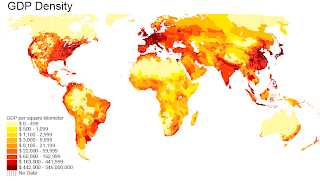
America’s global cultural chauvinism can be seen as a function of economic power. As America and Europe had the most economic power in the world, it was only natural that that Western culture would be more likely to be exported abroad in the form of not only products, but entertainment. The higher GDP per capita is the more disposable income consumers have to spend in such areas as entertainment, creating a more sophisticated pop-culture industry. As one can see by clicking on the above link, the majority of higher GDP per capita nations are still concentrated in North America and Europe. In Asia, only Japan, Korea, and Taiwan posess GDP per capita on a level equal to or higher than most European or North American nations. However, the global balance of economic power seems to be shifting ever increasingly away from Europe and America, and towards Asia, particularly China and Japan. As can be see on the graphic to the right there are already large concentrations of GDP in Japan, Korea, and North Eastern China equal to those in Western countries (indicated by deep scarlet). Japan has already reached a point where it is exporting culture to most of Asia in the form of Hamasaki Ayumi, Utada Hikaru, Johnny’s boy bands, manga, anime, fashion, and movies. Korea too has begun exporting its popular drama and music groups to the rest of Asia. With most of the acts listed before being fluent in several languages, including English, it seems only a matter of time before one of them makes significant waves on a more global scale.

BOA is a prime example of cultural globalization at work. She is a trilingual Korean singer whose biggest market is Japan, and her new album will be in entirely in English. She is demonstrative of the openness of Japanese culture to new ideas and culture from abroad. Japan has had a history of adopting foreign cultural ideas and rapidly remodeling it into something that is uniquely Japanese. In the same way, BOA’s Korean identity was not de-emphasized, however she was marketed as being kawaii ( the Japanese word meaning cute), a particularly Japanese image. She was presented as something both foreign, and therefore interesting, but also something safe. For that reason, her popularity in Japan easily exceeds her popularity in Korea, and the majority of her record sales and endorsements are in Japan. Narrowly she can be seen as part of the Korean Wave, the great increase in cultural exchange between Japan and South Korea, but more broadly as Japan’s growing openness to international trends, fashion, and culture.

The last time a Japanese artist had success in the U.S. was 1961, when a song called “sukiyaki”reached number one. Utada Hikaru, Japan's leading pop singer (both critically and commercially) attempted to release an album in 2005. Despite Utada having grown up in New York City and being a native speaker of the English language that effort failed to sell over 50,000 copies in the U.S. (although in Japan, it is the best selling English album ever). It is important to note that attempt involved a rather radical change of artistic representation that left Utada the artist in an awkward position. Her Japanese image is that of an intelligent, slightly dorky, musician, otherwise a multidimensional personality. However her American label decided to market her in different manner, most notably wearing a bikini under a clear raincoat for her lead single, “Easy Breezy”. In comparison to the video for either her previous Japanese single "Colors" or the following single "Be My Last", she is portrayed so differently as to almost make one wonder if it is the same person. If one goes further to actually analyze the lyrics you find an even greater disparity. The lyrics for both Japanese songs are sophisticated analyses on life and human. relationships, whereas the most memorable part of the American single was the line, "You're Easy Breezy and I'm Japaneezy". In order to sell albums, Island Records chose to reduce Utada to a one dimensional character that failed to resonate with the music buying public. American media commonly responds to Asian females, by exoticiing and over-sexualing them.

BoA also seems to be facing the same pressure to adapt to the American market, by presenting herself in a more aggressive and sexual manner in the video for the new single,"Eat You Up". When compared to the video for "Eat You Up" with either of her preceding Japanese singles,“Kissing You”and “Sparkle”, it is apparent that it has been decided to shift her away from a kawaii image towards a more sexual, urban image. This corresponds to previous portrayals of Asian women in American media. However, because this method did not work for Utada, it seems questionable how successful it will be for BoA. Fortunately for BoA, her lead single avoids any lyrical blunders on the scale of the before mentioned "japaneezy" line. It remains to be seen if BoA can create a image capable of engaging the American's public's attention, and then maintaining that attention long enough to establish a career.It will be difficult for BoA to carve out an individual artistic personality without first erroding stereotypes held by many Americans. As Asia becomes a more powerful economic presence, the amount of Asian culture that is exported abroad will likely chip away at American stereotypes. However, hit single or not, that may just be too late for BoA.

Saturday, September 20, 2008

Searching for a Cure: Financial Sector lessons from Japan

As the meltdown of the U.S. financial system continues apace, building on the already considerable losses from earlier in the year, the looming questions are “what went wrong?” and “ how do we fix it?” Each day the magnitude of the crisis seems to be getting worse. The tally reached a benchmark of $379 billion in July of this year, and is now estimated to have losses easily surpassing the trillions of dollars. In short, this is the worst financial crisis the U.S. has faced since the stock market crash of 1929. We now have to reevaluate what the real purpose of the U.S. financial system is, and what degree of regulation is necessary to achieve that vision.

Since the Japanese economic model was dismissed in 1989, the U.S. has been the predominant economic and financial model: advocating free markets and even greater liberalization of capital markets. The U.S. vision for the financial markets was one in which government played little to no regulatory role, where the markets would ultimately decide the direction of capital flows. In contrast to the U.S. model, Japan long advocated controlled use of capital through coordination between the government, banking, and industrial sectors. However, while Japan’s economy has quietly grown at a modest pace of 1-2% over the past 17 years, it has been outpaced by the stellar growth that the U.S. economy registered during the same period. In fact, when one takes a deeper look at the existing data a much different picture emerges as to which economy was better serviced by their respective financial systems.

With the gradual deregulation of the U.S. financial system, the economy adjusted to increasingly plentiful lines of credit by beginning a binge of borrowing. Not only did the U.S. government accrue debt at an alarming rate, the average American household used easy credit by borrowing against the value of their house, to fund a 15 year spending spree. At the same time, despite high economic growth, there has been a steep rise in income disparities , and due to rising prices, an actual decrease in living standards for the majority of Americans after 2001. This created an American economy that relied too heavily on credit borrowed from abroad and one too heavily focused around financial services as a basis of the economy.

Although often criticized for
growth rates that were considered too sluggish, during the same 17 year period Japan's economy managed to increase its trade surplus, household savings rates, and standard of living. Notably, such developments occurred in tandem with a reformation of the banking sector. The Japanese financial system is based on managed and cooperative use of capital. This involves cooperation between the government, large banks, and large companies to direct capital to towards areas of the economy that need capital. In a word, the Japanese financial sector still functions as a market, as the big banks still function in respect to profit, however the use of their money and speculation is more closely monitored than in the deregulated American system. The goal of the financial sector is not simply to make a profit, but also to direct capital toward developing industry for the purpose of international trade. Additionally, instead of using primarily foreign capital, the Japanese system relies primarily on domestic capital created through household savings. This means the individual savings of Japanese families are put towards developing the national economy in contrast to the American system where foreign money fueled consumer spending.

The Japanese system can hardly be called perfect, and has suffered its own serious downturns such as in 1989. However, the United States has suffered no more than three serious financial crises in the same period, with the current one being by far the worst. Alan Greenspan, the former head of the Federal Reserve Bank called it, " A once in a half century, probably once in a century, type of event." A financial system that is highly unregulated poses just as much of a danger to our society as a source of capital to help our economy grow. In particular, in the age of globalization, where the internet provides lightning fast communication, a deregulated financial system can too easily be misled by incorrect information and speculation.

Last week, the negative effects of speculation were clearly evidenced when short selling nearly f
orced several large investment banks such as Morgan Stanley into bankruptcy, despite their performance not being quite that bleak. In a deregulated system, we are more likely to see financial crises driven by greed, such as the current sub-prime mortgage crisis. They are more likely to spiral out of control as speculation forces even financially sound companies to their knees. The proponents of this system point to the vast amounts of capital it can make available for use, however, the use of that capital make a profit has negated the benefits it offered. In short, this system of finance is not one that has served our nation well: it has led to a massive accumulation of household debt, the erosion of industry, and a destructive wave of defaults that threaten the very foundation of our nation's economy.

In order to return the American economy to health, the instability of the financial system must be resolved by a degree of re-regulation by the government. When the Japanese Finance Minister,
Eisuke Sakakibara predicted the current crisis in American financial markets he stated the reasons as being, "that the global capitalism we now have is inherently unstable, and... We don't have the international mechanism to really prevent a crisis or to manage them when they occur." Therefore, the U.S. government, particularly the Federal Reserve Bank, must take a leading role, akin to Japan's Ministry of Finance and the Bank of Japan, in the regulation and direction of the finance industry. It is of profound importance that the financial tools available to raise capital for the economy are regulated and establish specific rules for the trading of such equity. Primarily the dependence of the U.S. economy on large investment banks should be broken, and those companies should be strictly regulated. Additionally, that system where over-consumption is encouraged through artificially low interest rates and excess capital is put to an end. Instead a policy the encourages savings by limiting access to easy credit such as mortgages, credit cards, and other forms of commercial borrowing for consumption. With higher savings the U.S. will have a decreased need on foreign capital to both finance our debt and to provide capital for business. Increased savings will also provide a considerable bulwark of funds both nationally and within the banking system itself with which to protect against further financial crises. Although there may be little we can do to correct the current crisis and the impending economic recession, through smarter regulation and coordination between the government, banking sector, and industry we might just be able to secure a better and healthier American economy for generations to come.
 
Creative Commons License
This work is licensed under a Creative Commons Attribution-Noncommercial-No Derivative Works 3.0 Unported License.